
High-volume hiring: How to find the good ones at scale

By Chris Woodward-Jones, CEO, Vizzy
We are entering a strange world of high-volume hiring. Candidates use AI to write their applications. Employers use AI to screen them. More and more, the first interaction in the whole process is one machine reading another; AI layered on AI.
I understand why it’s happening. Application volumes are high, hiring teams are stretched, and every candidate is trying to stand out in a crowded market. But I struggle to see who it helps. It makes it harder for the best people to stand out because every application starts to look equally polished and similar. And it makes it harder for employers to choose, because the signals they’re leaning on get weaker.
That’s the trap underneath most high-volume hiring. Faced with a flood of applications and so many roles to fill, the instinct is to filter harder or raise the grade bar, add a keyword screen, cut the pile down to something a human can read by Friday. But tightening a filter doesn’t always remove the weak applications. It removes the people who didn’t know how to write for the filter, and a lot of those are exactly the candidates you wanted.
Most advice treats high-volume hiring as a speed problem: how fast can you process and reject? It isn’t. It’s a signal problem: how reliably can you spot the good ones when you can’t read everyone’s CV?
What counts as high-volume hiring?
High-volume hiring is defined by how many roles you’re filling, but it could also be defined by the ratio: how many applicants land on each opening. When that number runs into the hundreds, the methods that work for a five-person shortlist will fall apart.
In the UK, high-volume hiring in early careers is now the default, not the exception. The Institute of Student Employers reported an average of 140 applications per graduate vacancy in 2025, the highest in the three decades it has tracked the figure, and up from 86 just two years earlier. In retail, FMCG and tourism, it hits 290 applications per role. A modest graduate recruitment intake of 50 places can mean reviewing well over 10,000 applications.
And that’s not it. In tech, there have been many layoffs in recent years, partly blamed on AI. Some businesses have been forced to do U-turns on their previous hiring plans after noticing customer satisfaction dropping post-automation. These decisions led to the need to rehire people in high volumes to fulfil the roles they thought could be fully automated by AI.
So how do you cope as a business with situations like these? Let’s get into it.
Why the usual playbook quietly fails
When volume spikes, most teams reach for the same three levers: a higher grade cut-off, CV keyword screening, and more automated rejections. Each one feels like control. Each one costs you, good candidates.
Start with the CV screen. A CV rewards one specific skill: writing a CV. That skill correlates with privilege, coaching and prior corporate exposure far more than it correlates with how well someone will do the job.
1. The automated screening trap
Harvard Business School and Accenture found that 88% of employers admit their own automated screening filters out qualified, high-skilled candidates simply because they don’t match the exact wording of the job description. Researchers call it the “hidden workers” problem, affecting an estimated 27 million people. You are not screening for ability. You are screening for the ability to mirror a job spec.
For an early-career employer, this is close to self-defeating, because most of your applicants have never written a CV before. A first-in-family graduate, a career-changer, a brilliant 21-year-old who spent their spare time building a side-hustle, doesn’t yet have the vocabulary to filter rewards. So you reject them at the gate and never know.
2. Clunky processes that applicants don’t finish
Then there’s the process itself. Long, clunky applications don’t deter the weak candidates; they deter the ones with options. Roughly 92% of people never finish the online applications they start, according to SHRM, and around 60% who quit cite the length or complexity of the form. Research from Hays puts the same point bluntly: most applicants abandon an application that takes longer than 15 minutes. Every field you add to “manage” volume is quietly removing the people who could go elsewhere.
3. Silent rejections in the form of ghosting
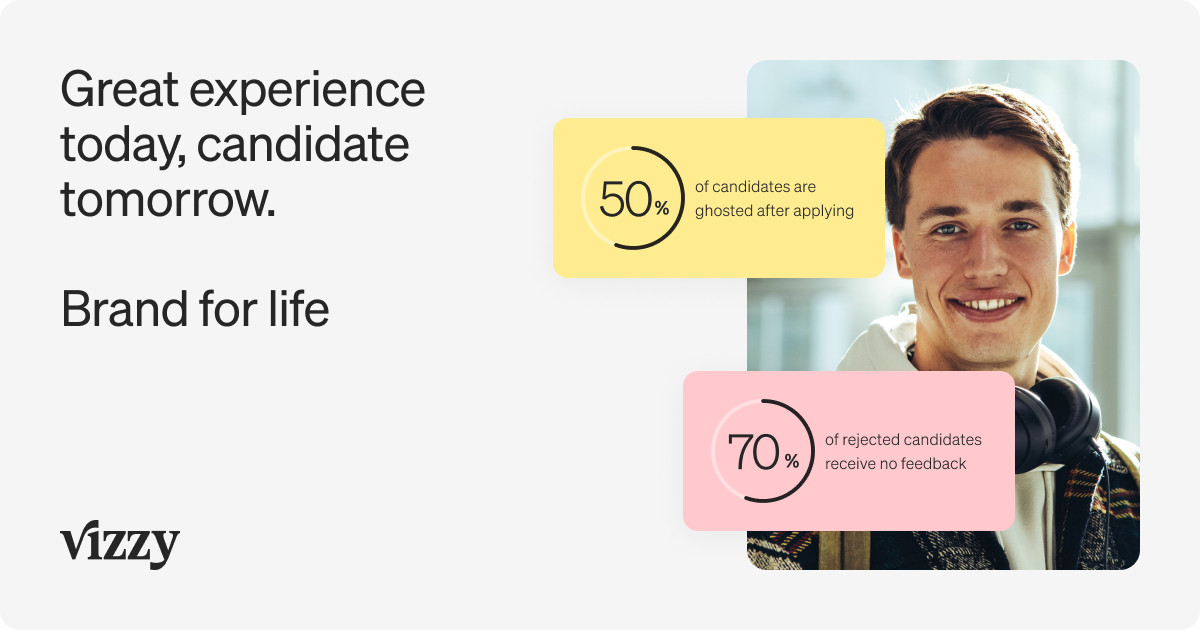
And the final lever is the silent rejection, which does the longest-term damage. More than half of candidates are now ghosted after applying, and close to 70% who are rejected receive no feedback at all. In early careers, you’re hiring from the same pool again next year, and those candidates talk. A bad high-volume process isn’t just an operations problem; it’s also an employer-brand problem.
Screen for signal, not throughput
The way out isn’t a faster funnel. It’s a better question at the top of it.
Instead of asking “how do we cut this pile down,” ask “what would actually tell us this person can do the job?”, and then collect that thing at scale, instead of collecting CVs. For early-career roles, the strongest early signals are rarely on a CV. You could screen for:
- How someone thinks through a realistic problem
- What they’ve made or done
- How they communicate
- What they’re genuinely interested in
This is the shift we built Vizzy for Businesses around. A content-rich candidate profile lets someone show their skills, work and personality up front, so the people reviewing 2,000 applicants are looking at evidence of potential rather than ranking CV formatting.

The point isn’t to add a step. It’s to replace the weakest step, the CV gate, with one that actually predicts who’s good.
Here’s what Vizzy looks like for candidates. Check out our gallery of you.
A high-volume hiring process that holds up
Once you’re optimising for signals, the process almost designs itself. In order:
1. Define the genuine must-haves before you open the role
Be ruthless about the difference between “needs this to do the job” and “would be nice.” Every nice-to-have you screen on shrinks the pool and disproportionately removes non-traditional candidates. For most early-career roles, the list of true must-haves is shorter than people expect.
2. Replace the CV gate with a scalable signal
Ask every applicant to show the same role-relevant thing, how they’d approach a real task, a piece of work, a short structured response; so you’re comparing like for like. This is what lets you assess thousands of people on ability rather than pedigree.
3. Sequence the funnel so human time goes to the shortlist
Use a lightweight, consistent signal to surface the strongest candidates, then put your assessors’ attention where it changes outcomes. On the people most likely to convert and succeed, not on the slush pile.
4. Build rejection and feedback into the flow
Even a short, automated, respectful “no” protects the employer brand you’ll need next year. This is not a nicety. And it could help fill your candidate pipeline back up one day.

Measure the right things
High-volume hiring has a favourite vanity metric: time-to-fill. It’s easy to measure and easy to game, and on its own, it tells you nothing about whether you hired well.
The metrics that matter are the ones tied to outcomes. Quality-of-hire and early retention tell you whether your signal is real. Offer-acceptance rate tells you whether candidates wanted to say yes. A candidate-experience score tells you what next year’s pipeline will think of you. Diversity of the shortlist tells you whether your top-of-funnel is widening or quietly narrowing. Track those, and “faster” stops being the goal; “faster at finding the right people” takes its place.
Where this leaves you
The employers who win at high-volume hiring in 2026 aren’t the ones with the tightest filter. They’re the ones who stopped treating volume as something to survive and started treating it as a wider net, a chance to find the people the CV screen has been quietly throwing away.
The standout candidate is somewhere in your pile. The only question is whether your process is built to see them or built to filter them out at applicant number 1,847.
Hiring early-career talent at volume? See how Vizzy lets you assess thousands of candidates on skills and potential, not CVs.
Related stories

Why Virgin Group ditched traditional CVs in favour of ‘Vizzy’ digital profiles
By Peter Crush for HR Grapevine Virgin Group has partnered with technology company, Vizzy to give jobseekers a chance to give their…
HR Magazine: How to hire for personality, not just experience
By Jess Woodward-Jones, co-founder of Vizzy for HR Magazine Talent can’t be judged by work experience alone. Let’s give personality more consideration…

How to Stand Out When Everyone Uses AI
Vizzy CEO and Co-founder Chris Woodward-Jones chats to George Pygall from Skill Economy podcast about standing our in a world where everyone’s…