
Why Virgin Group ditched traditional CVs in favour of ‘Vizzy’ digital profiles
By Peter Crush for HR Grapevine
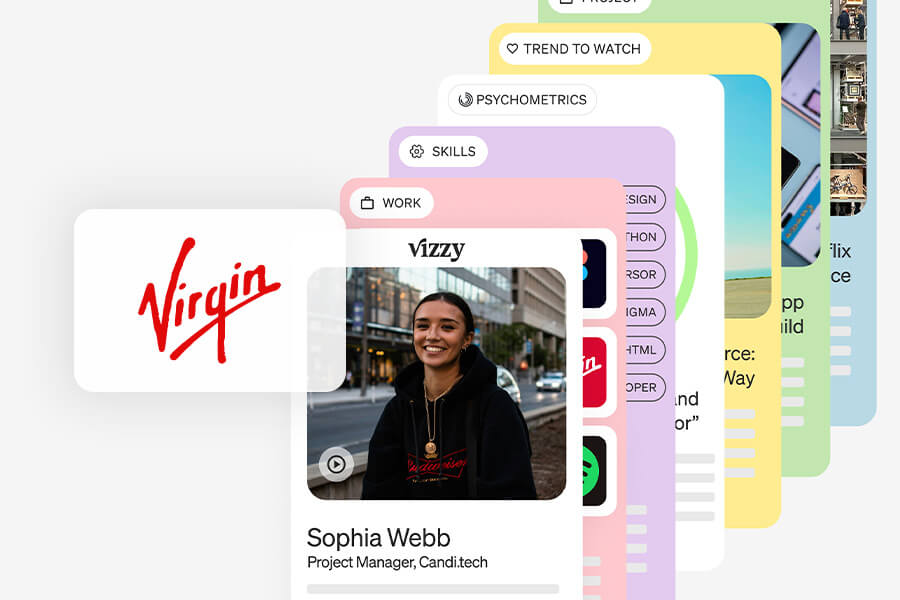
Virgin Group has partnered with technology company, Vizzy to give jobseekers a chance to give their CV a digital makeover (and stand out from the crowd)…
Last month, Denis Machuel, CEO of staffing group, Adecco Group, admitted that the average job seeker now has to send an average of 200 CVs out just to land a single job offer. It is a jobseekers market no more.
The only problem, however, is that the only way candidates can realistically do this is by (inevitably) turning to AI – and using it to fire off more applications faster.
But employers – and particularly Virgin, which prides itself in wanting to see people’s ‘real’ self – was finding that it was not impressed with this increasing copy-and-paste, scatter-and-hope approach.
“Here at Virgin, we pride ourselves in being forward-thinking about the way we do our recruitment,” says Sarah Lock, Recruitment & People Operations Lead at Virgin Group. “In this world of AI though, even 18 months ago, we were starting to find that CVs were coming in all looking the same.”
She continues: “We were getting an average of 230 CVs per advertised role. But from a candidate perspective we didn’t think people were necessarily being given the opportunity to shine. We felt something needed to be done about it.”
“In this world of AI though we were starting to find that CVs were coming in all looking the same” Sarah Lock | Recruitment & People Operations Lead, Virgin Group
In a moment of good timing though, just as Virgin was looking for a solution to this, came a meet-up with a relatively new called business called Vizzy. The business is the brains of co-founders Jess Woodward Jones and her brother Joe, the son and daughter of England Rugby World Cup Winning coach, Sir Clive Woodward.
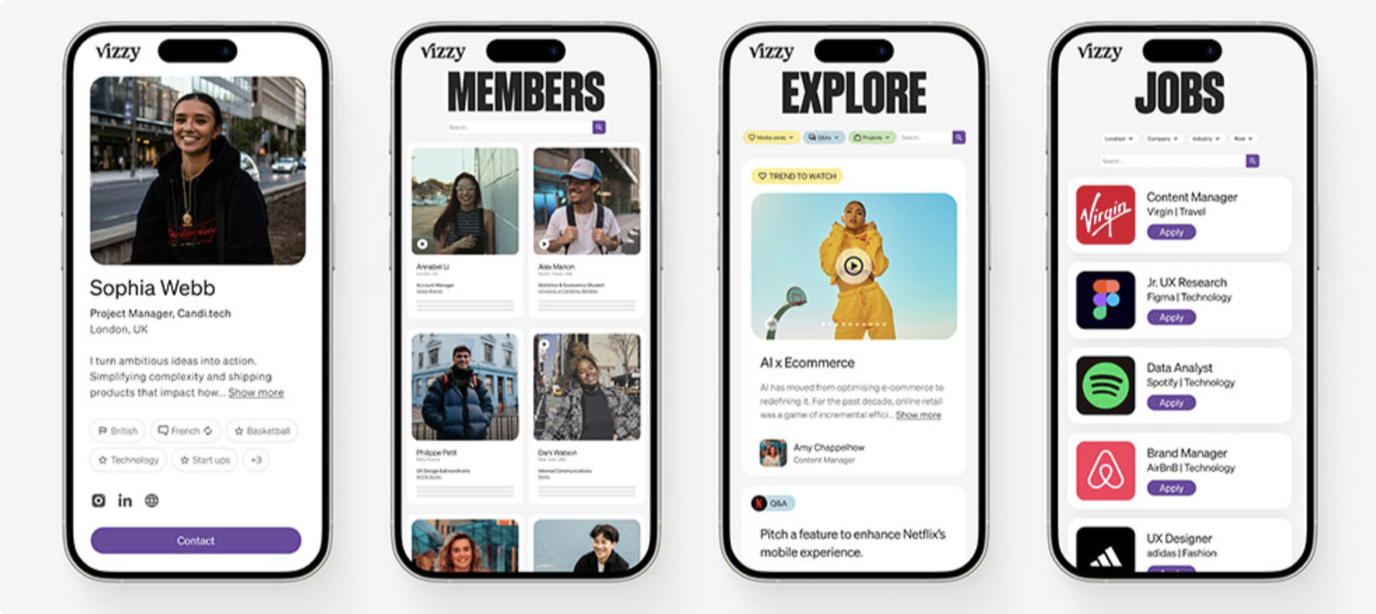
Vizzy creates what Woodward Jones calls a much more modern digital profile of a person – a ‘Vizzy’ – which is far more graphical in nature, includes videos candidates might have done, and has the ability to be populated with other types of media.
“If a traditional CV and Pinterest had a baby, it would be a Vizzy,” says Woodward Jones, speaking to HR Grapevine.
“Candidates can create their basic profile, but then they can add handles from say Instagram or other social media sites; have their own personal biography; add video, and basically add tonnes of other elements that really brings their former CV to life.” She adds: “There’s a section with their psychometric personality profile, and all-told, its very snackable for talent heads to then be able to look at and search through.”
Born out of a need for candidates to better showcase themselves
Vizzy was founded in 2020, when Joe Woodward lost his job during the Covid-19 pandemic, and he suddenly found that his own CV didn’t seem to be doing him justice. Says Woodward Jones: “He felt that if it was really difficult for him, even with several years’ experience under his belt, how hard must it be for young people to demonstrate who they are and what they can do without having a long job history behind them?”
“If a traditional CV and Pinterest had a baby, it would be a Vizzy” Jess Woodward Jones | Co-founder, Vizzy
Candidates can create their basic Vizzy by inputting all the detail from their existing CVs, but it really comes to life when they personalise it – perhaps by adding details of their side hustles, or answering specific questions (there is a template to choose from) with multi-media options. Employers, meanwhile, can customise what they want to see from a Vizzy (ie they can screen-out details such as age or education etc), and search against criteria they set, or even require candidates to answer specific questions just for them.
“Our concern was that the recruitment funnel was getting crazy at the top,” says Woodward Jones. “So this is where candidates are really able to stand out.”
According to Virgin, which first started asking candidates for Vizzys last year (and initially with entry-level roles), the ambition is both to make candidates work a bit harder – by requiring them to put a bit more effort into their Vizzy – but also to then make it easier for Virgin to really see potential, by allowing candidates the chance to show their real self.
“As a business, we’d already made the decision to remove verbal and numerical assessments, because we felt they were biased to the neuro-typical, and they didn’t accurately show people’s potential,” says Lock. “We don’t run assessment centres either, and I’m most proud to say we don’t use AI in our shortlisting. But what we do therefore need, is for our candidate funnel to show is people’s ‘real’ skills and potential. We feel the Vizzy levels the playing field, and gives our hirers a ways of assessing talent in a different way.”
Democratising the process too
According to both Lock and Woodward Jones, Vizzys don’t reward those that simply have better multi-media skills, or those who are able make their profile ‘pop’ more than others.
“We give people a choice which media they use to craft a Vizzy,” says Lock, and whatever they choose doesn’t count against them, because we’re more interested in what candidates are able to show, or the way they go about it. In one of our roles, it’s essential candidates have a passion for the climate, and we looked at how they brought this passion into their Vizzy.”
“We don’t use AI in our shortlisting so our candidate funnel has to show is people’s ‘real’ skills and potential” Sarah Lock | Recruitment & People Operations Lead, Virgin Group
She continues: “Right now, we know that for certain roles – such as marketing – people can come into it from so many sectors, because of the transferable skills they can bring. The aim of the Vizzy is not to discount people, and allow them to show their transferable skills better. In turn the ambition for us is to get better quality of applicants – and this means our talent acquisition team can actually spend longer going through the Vizzys, and devoting proper thought to each person applying.”
Results that do the talking
Although Virgin doesn’t mandate that candidates have Vizzys for all roles, it has expanded them from just entry level jobs, to even include those for some director-level roles. It is also experimenting, confirms Lock, with using them for internal hiring too, because this way they can showcase how people that are already at Virgin can think about their careers, by showing them how they could be more suitable for other roles in areas they might not have thought about.
“The key results statistic for us,” says Lock, “is that through this, we’re seeing a 70% drop-off in application numbers for roles – perhaps because people can’t now fire their CV off and quickly use AI to change it. Now it involves them putting a bit more effort in. But the payback is then that they’re competing with fewer people, and we can really spend time assessing these fewer numbers properly.”
Broadly, Vizzy’s own research reveals that when companies work with them, they move beyond the static CV, and much more into uncovering richer insight into candidates’ potential and motivation.
For Virgin specifically, Vizzy reports achieving 0% job offer reneges and a 100% retention rate across all roles hired through Vizzy in 2025.
Overall there has been a 77% reduction in CV screening volume – which saves hiring managers an estimated three days’ per role – and anecdotally Lock confirms the quality of applicants has been significantly improved.
Perhaps best of all, this novel approach is something that candidates themselves buy into – perhaps realising that the scatter and hope method no longer does them any favours. Vizzy says Virgin has achieved 4.7 out of 5 star average candidate experience ratings from 815 applications.
“The quality of our hires is really brilliant,” says Lock. “Also, our hiring managers are now much more confident about making their selections.” She continues: “Time to hire is also improved, and candidates tell us that this sort of experience for them is more inspiring, innovative, and gives them the chance to show who they really are. It really is an opportunity for them, to show off their transferable skills.”
Says Woodward-Jones. “Employers are now able to see potential in a whole new different way. It’s not about who can make the most flashing profile. Some 46% of employers using Vizzy now are in the non-creative sector.” She concludes: “At the moment, I think something has to give in the recruitment sector. This is digital first. Effort has to go back to the applicant, but at least this way, people are going to be seen.”
www.hrgrapevine.co.uk