
Candidate experience now shows up on your P&L

By Chris Woodward-Jones, CEO and co-founder, Vizzy
In 2026, the average person sends around 200 applications before they get a single offer. That figure comes from Denis Machuel, CEO of the Adecco Group, as reported by Yahoo Finance, and it tells you everything about the state of candidate experience right now. Two hundred attempts. Two hundred forms, two hundred CVs tuned to beat a filter, and for most of them, two hundred silences.
I’ve spent the last six years building an alternative to the CV, after my co-founder Joe couldn’t get a flat black-and-white document to say anything true about what he’d actually done. Along the way, I’ve watched the same thing happen on the employer side, from Burberry’s graduate intake to Virgin’s early-careers hiring: the volume has broken the experience. And a broken experience is no longer a soft problem. It’s a number on the P&L.
What candidate experience actually is
Candidate experience is the sum of how someone feels about your company across every interaction in your hiring process: the job advert, the apply button, the assessment, the wait, the interview, the rejection or the offer. Not how slick your careers page looks. How it felt to be on the other side of it.
That last part is the bit most teams skip. You can have a tidy ATS and a fast time-to-fill and still run an experience that quietly tells people you don’t value them. The candidate doesn’t see your funnel. They see whether anyone got back to them.
Candidate experience vs employer brand: they’re not the same thing
These two get used interchangeably, and the confusion costs employers real money. Your employer brand is the promise, the marketing, the values on the careers site, the reason someone clicks “apply” in the first place. Candidate experience is whether you keep that promise once they do.
When the two diverge, candidates notice instantly. As I said to UNLEASH earlier this year, you can tell within seconds when you’re being put through a generic process built for the company’s efficiency rather than your engagement. The excitement your brand built up evaporates at the apply button. That gap between what you promised and what you delivered is where employer brand damage actually happens. Not in the advert. In the experience.
Why candidate experience matters more than the spreadsheet suggests
Here’s the case that should make a CFO sit up, not just a head of talent.
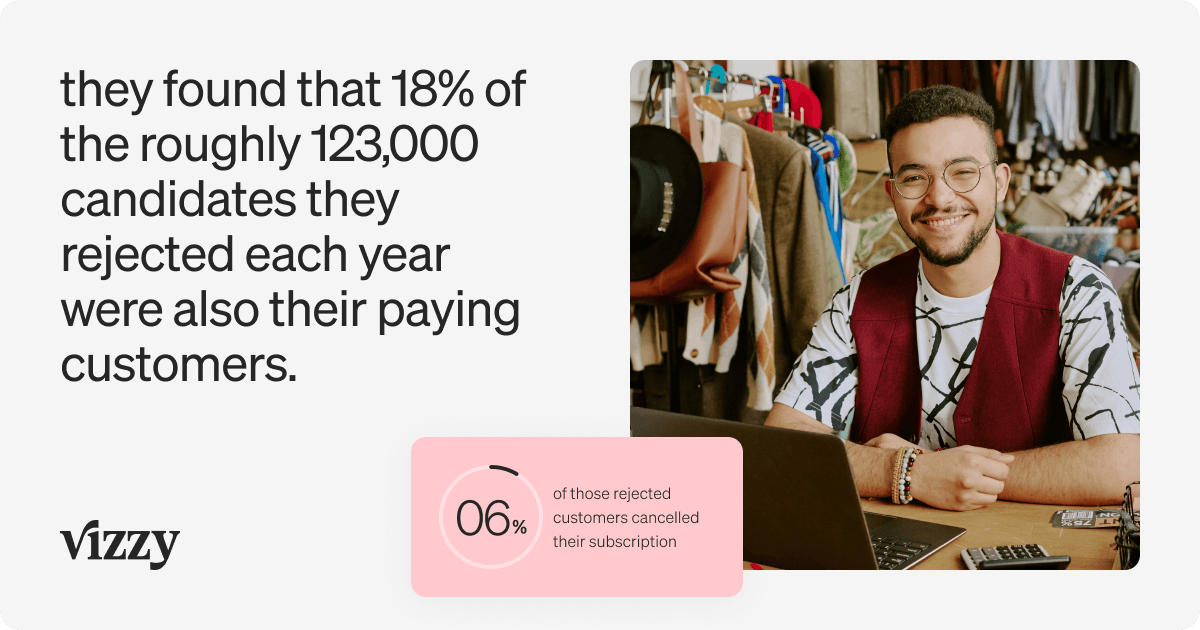
When Virgin Media measured this properly, they found that 18% of the roughly 123,000 candidates they rejected each year were also their paying customers. About 6% of those rejected customers cancelled their subscription after a poor experience, roughly 7,500 people walking away. At about £50 a month each, that added up to an estimated £4.4 million in lost revenue a year, almost the size of their entire recruitment budget. They turned it around by treating candidate experience as a commercial metric, and it’s no accident Virgin now hires on more than a CV.
The reputational maths is just as unforgiving. Talent Board’s research found that 41% of candidates who have a bad experience will cut their ties with that employer: stop buying, stop referring, stop applying. Every rejected applicant is a potential customer, a potential reapplicant, and a potential reviewer. You’re not just filling a role. You’re shaping how a few thousand people a year feel about your company.
And the baseline is getting worse, not better. Employer ghosting hit 53% of job seekers in 2026, up from 48% the year before and 38% in 2024. Of the candidates who reach the interview, 61% have been ghosted afterwards. Feedback tells the same story: 94% of candidates want it, only 41% get it. So when you do get the basics right, you stand out because so few employers bother.
The real problem: you’re optimising the wrong end of the funnel
Most candidate-experience advice tells you to send a nicer rejection email and shave a day off your time-to-fill. Useful, but it’s treating the symptom.
The actual problem is that the modern hiring funnel is built to reject at scale, and the experience rots from there. AI has flooded the top: our own data shows more than 60% of CVs and cover letters now carry some AI contribution. Employers respond by armouring up with their own filters. So you get AI writing the applications and AI screening them, and as I’ve said before, tech is quietly killing trust, because no one’s sure they’re even assessing a human anymore.
When your whole process is designed around getting rid of people quickly, the experience you deliver is, inevitably, the experience of being got rid of. You can’t paste good candidate experience on top of a process whose core function is rejection. The candidates who suffer most are exactly the ones early-career employers say they want: the first-in-family graduate, the career-changer, the person with real ability who hasn’t yet learned to write a CV that games the filter.
My view is simple, and it’s the thing I’d ask every talent leader to sit with: talent is everywhere, opportunity isn’t. The job of a hiring process isn’t to reject 2,000 people as efficiently as possible. It’s to give people the room to show you something real, and to give your team the signal to spot it. Do that, and the experience fixes itself, because a process that lets people show who they are is a good experience.
How to improve candidate experience (without slowing down)
You don’t fix this with a survey at the end. You design for it. Here’s the order I’d do it in.
1. Map the candidate experience journey from their side
Walk your own process as a candidate. Count the clicks to apply, the days of silence, the points where a human could have said something, and a template did instead. Most teams have never done this, and it’s the cheapest, most revealing hour you’ll spend. You’re looking for the moments where your employer brand promise and your experience come apart.
You might also like to read: How To Build A Graduate Recruitment Strategy (For Gen Z)
2. Replace the CV gate with something that shows signals
The CV is where candidate experience and hiring quality both fail at once. It asks people to flatten themselves into a format that rewards CV-writing skill over ability, and it gives your team almost nothing meaningful to decide on. Let candidates show what they can do, how they think, and what they care about; projects, work, a point of view, and you improve the experience and the decision in the same move. This is the whole reason Vizzy exists.
3. Use AI for the busywork, never the decision
This is the line I won’t move on. AI belongs on the scheduling, the note-taking, the admin that eats a trained recruiter’s day, so they can get back to candidates faster, in greater volume, with more clarity. AI does not belong in the decision about a human being. Use it to give your team time back, then spend that time on the thing only a person can do: actually engaging with applicants.
4. Close every loop – especially the rejections
With 53% of candidates being ghosted, simply replying puts you ahead. Tell people where they stand. Give the ones who reached the interview something useful. The rejected candidate who was treated like a person is the one who reapplies next cycle, refers a friend, and keeps their subscription. The one who was ghosted tells the internet.
5. Measure candidate experience like you mean it
Pick metrics that reflect how it felt, not just how fast it went: candidate NPS, application completion rate, time-to-feedback, and offer-acceptance rate. Time-to-fill on its own is a vanity metric, you can hit it while delivering a terrible experience. And only 25% of employers even ask candidates for feedback, so the data is a competitive edge most of your rivals are ignoring.
Where Vizzy fits
We built Vizzy for Business to make a good experience and a good hire the same thing. Instead of asking candidates to compress themselves into a CV, your team then has to screen out. We give them content-rich profiles to show their skills, work, personality and potential, and we give hiring teams the tools to read those signals at volume.
For employers facing the application flood, it does two things at once. It delivers a smaller, more engaged talent pool; we’ve cut screening loads by 35–75% for enterprise clients like Tiffany & Co., Virgin Group and Louis Vuitton, and saved hiring teams up to 80% of their time. And because candidates are showing you who they are rather than being filtered out in silence, the experience itself improves.
Vizzy’s candidate experience rating is 4.8/5 from over 75,000 submissions and over twice as many people submit a Vizzy compared to other online assessments (SHRM, 2025)
Burberry was our first client, using Vizzy to run a global campaign for its undergraduate programme in place of a standard application.
The shift worth making
For years, we’ve asked candidates to prove themselves in a format built for the company’s convenience, then wondered why the experience feels cold. The employers winning early-career talent in 2026 have flipped it: they’ve stopped optimising how quickly they can reject people and started designing for how it feels to be considered. That’s not softness. As Virgin Media’s numbers show, it’s revenue, brand and pipeline in one.
If you want to see what hiring looks like when candidates can show who they really are, and your team gets the signal to act on it, see how Vizzy works for businesses.
FAQs
What is candidate experience?
Candidate experience is how a job seeker perceives and feels about an employer throughout the entire hiring process – from the job advert and application to assessment, interview, and the final offer or rejection. It covers every interaction, and it shapes whether that person becomes a hire, a future applicant, a referrer, or a critic.
Why is candidate experience important?
Because it directly affects revenue, employer brand and hiring quality. Virgin Media found that a poor candidate experience was costing it an estimated £4.4 million a year in cancelled subscriptions from rejected candidates who were also customers. Talent Board research shows 41% of candidates who have a bad experience cut commercial ties with the employer. Rejected candidates are customers, reapplicants and reviewers, not just unsuccessful applicants.
How do you improve candidate experience?
Walk your own process as a candidate to find the friction; replace CV-only screening with ways for candidates to show real skills and personality; use AI for admin rather than decisions so recruiters can respond faster; close every loop, including rejections, with clear and useful feedback; and measure outcomes like candidate NPS and time-to-feedback rather than time-to-fill alone.
How do you measure candidate experience?
Track candidate NPS, application completion rate, time-to-feedback, offer-acceptance rate, and post-process survey scores. These reflect how the process felt, not just how fast it ran. Only around a quarter of employers currently ask candidates for feedback, so doing it well is a genuine advantage.
What’s the difference between candidate experience and employer brand?
Employer brand is the promise you make to attract candidates, your values, marketing and reputation. Candidate experience is whether you keep that promise once someone applies. When the experience falls short of the brand, the gap damages your reputation faster than the brand built it.
Does using AI hurt candidate experience?
It depends entirely on where you point it. AI used to filter and reject candidates erodes trust and makes the process feel impersonal. AI used to remove recruiters’ busywork – scheduling, note-taking, and admin frees them to respond faster and engage more, which improves the experience. The decision about a person should stay with that person.