
Bias in recruitment hides in the CV sift, not the interview
By Chris Woodward-Jones, CEO & Co-founder, Vizzy
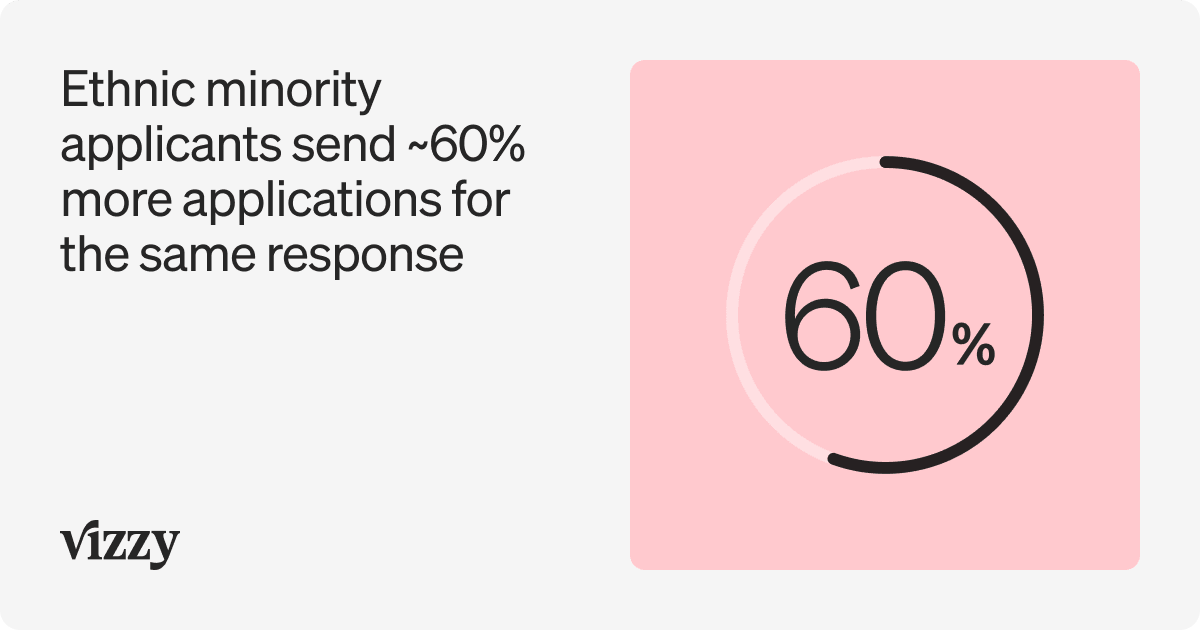
Applicants from ethnic minority backgrounds in Britain have to send about 60% more applications than white British applicants to get the same number of positive responses. That figure comes from an Oxford study that sent nearly 3,200 fake but equivalent applications to real jobs, and the most sobering part isn’t the number. It’s that the researchers found discrimination at levels unchanged since the late 1960s. Fifty years of good intentions, diversity statements and unconscious bias training, and the gap at the first gate has barely moved.
I find that gap infuriating, because it’s a waste as much as an injustice. The premise of Vizzy is that talent is everywhere and opportunity isn’t, and bias in recruitment is one of the main reasons the two don’t meet. So this piece is about where that bias actually lives in a hiring process, why the standard fixes keep missing it, and what genuinely moves the number.
What bias in recruitment actually is
Bias in recruitment is any systematic tilt in who gets progressed that isn’t based on their ability to do the job. Some of it is conscious, most of it isn’t. The recurring forms are worth naming, because you fight each one differently:
Affinity bias, the pull towards people who remind us of ourselves, is why teams quietly hire in their own image. Name bias is the one the Oxford study measured: a recruiter sees a name they read as foreign and, as the authors put it, may read no further. Education and prestige bias treats the brand of a university or a former employer as a stand-in for quality. Confirmation bias makes us seize on the detail that fits our first impression and discount the rest. None of these require anyone to be a bad actor. They’re how a hurried brain sorts a big pile quickly.
Unconscious bias vs process bias: the distinction that matters
Most employers treat bias in recruitment as a people problem: individuals hold biases, so we train the biases out of them. That framing is where the effort goes, and it’s largely why the effort fails.
The more useful distinction is between the bias in someone’s head and the bias built into the process. You can’t reliably train away the split-second judgement a recruiter makes on a name in a seven-second CV scan. What you can change is whether they see the name at all, what information they get first, and whether every candidate is judged against the same defined criteria. Unconscious bias is a fact about human attention. Process bias is a design choice. The winnable fight is the second one, because you control the process and you don’t control the reflex.
This is why the honest research on unconscious bias training is deflating. It can raise awareness, but there’s little evidence it changes hiring decisions on its own. Treating a design problem as a training problem keeps the bias exactly where it was.
Why this matters, beyond fairness
The stakes are both moral and commercial. A King’s College London analysis of CV field experiments found the callback penalty for ethnic-minority-sounding names has been remarkably persistent across decades and countries. This isn’t a fringe effect at the margins. It’s a structural leak at the top of the funnel, and it’s been leaking for fifty years.
The commercial cost follows directly. Every strong candidate filtered out on a proxy is a hire your competitor gets to make instead. Bias doesn’t just produce an unfair shortlist, it produces a worse one, because it screens on things that don’t predict performance. When Virgin Group moved off traditional CVs, they described it as levelling the playing field, and the point wasn’t only fairness. A level field is how you see talent you were previously rejecting without realising.
The real problem: the bias is baked into the CV
Here’s the insight most anti-bias programmes miss. The CV is not a neutral document that a biased reader distorts. The CV is itself the instrument of bias, because of what it puts front and centre: a name, a home address, a university, an employer’s brand. Every one of those is a trigger for exactly the biases above, and they sit at the top of the page, read in the first two seconds.
Name-blind recruitment is the honest attempt to deal with this, and it helps. The UK Civil Service has anonymised applications at the sift stage for most external roles for the best part of a decade. But name-blind only masks one field, and only at one stage. Strip the name and a reader can still infer background from the postcode, the school, the gap in a work history. And when UCAS piloted name-blind university applications, the results were inconclusive, partly because so many other signals leak through. Hiding the name treats a symptom. The disease is that we’re asking candidates to compete on a document made of proxies in the first place.
For early careers, the population Vizzy works in, this is at its worst. A first-jobber’s CV is mostly education and background, because there’s little work history to crowd those signals out. So the CV of a graduate is close to a pure background signal, which is close to a pure bias trigger. Screen early-careers talent on CVs and you are, in effect, screening on where they came from.
How to reduce bias in recruitment
1. Fix the process before you train the people
Assume you can’t train away the reflex, and redesign the process so the reflex has less to act on. That’s not defeatism about people; it’s putting effort where it pays. Awareness sessions can support a redesigned process, but they can’t substitute for one.
2. Assess skills at the first gate, not the CV
The single biggest lever is changing what candidates are judged on at the sift. If the first filter acts on evidence of what someone can do, a structured task, a work sample, a demonstration, it has far less room to act on their name or their school. This is also why structured, skills-based assessment predicts performance better: the fair move and the accurate move are the same move.
3. Standardise everything you can
Same questions, same scoring, same criteria for every candidate (per role). Structured assessment consistently outperforms unstructured “chat and gut feel”, both for accuracy and for fairness, because it removes the space where affinity bias does its work.
4. Anonymise, but know its limits
Strip names and photos at the sift as a floor, not a ceiling. It reduces the crudest name bias, but it won’t touch the inferences a reader draws from other fields, and it does nothing at interview. Treat it as one layer among several, not the whole answer.
5. Measure bias at every stage, not just the top line
A single diversity headline hides where the funnel leaks. Track progression rates by stage, because bias creeps back in through whichever stage you don’t watch. Decide what a fair funnel looks like and hold the process to it.
Where Vizzy fits
This is the problem we built Vizzy to solve, so I’ll be straight about it. If the CV is the instrument of bias, the fix isn’t to redact the CV, it’s to replace what candidates lead with. A Vizzy profile puts a person’s skills, work and character first: projects with the work attached, short video answers to structured questions, evidence of what they can actually do. The name and the postcode stop being the headline. What they can do becomes the headline.
That’s not a diversity add-on, it’s a different top of funnel. Give candidates room to show who they are and, in our experience, they share far more real signal than an application usually captures, which is precisely the signal a biased CV sift throws away.
Virgin Group, Louis Vuitton, Puig, and Beazley use Vizzy to reach talent a CV-first process was quietly filtering out.
The shift worth making
Bias in recruitment has survived fifty years of training because we’ve been treating it as something in people’s heads rather than something in our processes. The reflex on a name in a seven-second scan is not going away. What can go away is a first gate that leads with a name, an address and a school, and asks a hurried reader to be fair anyway.
If you’re rebuilding early-careers hiring so people compete on what they can do rather than where they’re from, book a demo and see how Vizzy works. For the related move on the accuracy side of this, read how to do skills-based hiring properly.
FAQs
What is bias in recruitment?
Bias in recruitment is any systematic tilt in who gets progressed that isn’t based on their ability to do the job. It includes affinity bias (favouring people like us), name bias, education and prestige bias, and confirmation bias. Most of it is unconscious, and most of it concentrates at the CV screening stage, before anyone properly assesses ability.
What are the main types of bias in recruitment?
The most common are affinity bias (hiring in your own image), name bias (judging a candidate on how their name reads), education or prestige bias (treating a university or employer brand as a proxy for quality), and confirmation bias (over-weighting details that fit a first impression). Each needs a different fix, but all are triggered by the proxy information a CV puts first.
Does unconscious bias training work?
There’s little evidence that unconscious bias training changes hiring decisions on its own. It can raise awareness, but the reflex it targets happens too fast to reliably train away. Redesigning the process, so candidates are assessed on skills and against standardised criteria, does far more than trying to train the bias out of individuals.
Is name-blind recruitment enough to remove bias?
No. Anonymising names at the sift reduces the crudest name bias and is worth doing, but a reader can still infer background from other fields like postcode, school or career gaps, and it does nothing at the interview stage. It’s one useful layer, not a complete solution. Changing what candidates are judged on matters more than hiding one field.
How do you reduce bias in recruitment?
Fix the process rather than only training people: assess skills at the first gate instead of the CV, standardise questions and scoring across every candidate, anonymise as a baseline, and measure progression rates at each stage so bias can’t hide in an unwatched step. The most effective single change is judging candidates on evidence of what they can do, as early in the process as possible.